Behind Oakmoor House’s Glass Furnace
When creating Oakmoor House, its defining characteristic was its ballroom’s stained-glass ceiling (as well as stained glass throughout the rest of the townhouse.) Although stained-glass ceilings weren’t around until after the Regency, I chose it anyway because its duchy is known for its fantastic artisans and Oakmoor’s suave affluence demanded a vibrant and intricate setting. Plus, I could picture Oakmoor and Juliet dancing together in such a vivid, almost magical ballroom (and what happens when they break his beast curse.)
As I considered Oakmoor House further, I pondered the history behind its stained-glass ceiling installation, and I realized Oakmoor’s ancestor who had commissioned that extravagant ballroom must have adored stained glass and would have enjoyed dabbling with it himself. So he would have had workrooms constructed at Oakmoor House (and Oakmoor Castle) intended for working with glass. (Which would also make wonderful places for Juliet to use as her magical workrooms.)
I’ve always loved watching glassblowing demonstrations at Renaissance fairs (I never miss them when I go!) because the patient artistry that creates such lovely pieces using sand and fire is fascinating. Yet I knew nothing about glass making beyond that. So I began researching the history of stained glass and glass making to determine how Oakmoor House/Castle’s glass workrooms should look.
I discovered so many fascinating rabbit holes, from various methods to make stained glass (painting clear glass or adding component to change the glass’s color) to how best to construct a stained-glass ceiling (starting with the steel framework then adding glass from the outside inward) to the innovative and artistic Murano glass from Venice, which was the major center of luxury glass in the Middle Ages and the Renaissance. They still have historic glass factories on Murano Island today, and I found a fascinating article about how those glasshouses looked.
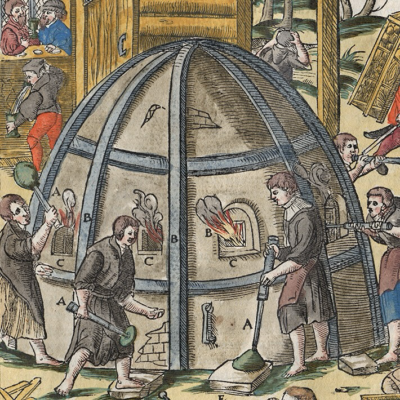
Using that article and videos from modern glass-making studios, I created how Oakmoor House/Castle’s glass workrooms should look. They would be massive rooms on the ground floor with plenty of light and fresh air (i.e. many large windows) to facilitate the glass making and keep the temperature down. At their heart would be the glass furnace, a domed (beehive-shaped) brick furnace with multiple openings for various stages of glass making. And to work with the glass, the workrooms would have metal tables since wood ones would catch fire.